Like a River
I wrote this piece to speak out loud at the International Beaver Symposium on 17-19 September 2025 at UHI House in Inverness.

This story, like a river, has many beginnings. It begins with some children paddling in a farm ditch. Us. Us in flannel tracksuits, green and red. Us in blue and white striped shorts with red stitching. The sunlight coming back at us from the water. The smell of sheep, pieces of their fleece and their faeces on the ground around us. Water cress tangled by the stone bridge. Sometimes we try to dam the ditch. It is only a metre wide. We lift big, wet stones in our hands and arms. We slip on wet stones in our bare feet. We patch the dam with mud. We watch the water fill up behind and spill through the gaps.
It begins with Paul, my father, at a meeting in which a presenter describes how our ancestors slaughtered thousands of beavers from the rivers of Britain, erasing their peak backed, flat tailed, 50 pound forms, extinguishing the warmth of their bodies, to steal the coats off their backs. ‘Yes’ he cries out, with his hand in the air ‘we must bring them back.’
It begins in a wetland, the start of a ditch, becoming a burn, which joins a burn, which joins a river, which joins a river, which flows into the sea at Dundee, our water becoming lost amongst all the other waters, becoming brackish, becoming the sea. This wetland, the ‘Wet Wood’, is where it starts. An enigmatic flat place, peered into by a half naturalised conifer wood on one side, and a young oak wood on the other. Between these, a line of accidental grey alders, and some dancing willow.
It begins when two beavers arrive, and are released into an enclosure in the Wet Wood. A winter day in early 2002. I am visiting from university with my friend Kate. This is what she says:
I remember that day very well… As one came out of the crate, it put its paw on my hand. I remember how velvety the leather felt and my surprise at the fingernail-like-ness of the short claws. We looked at each other for what felt like a long moment and then we went our ways.
Coming and going from Bamff, over months and years, I see the landscape change. The Wet Wood shifts and shifts over seasons and time. Its enigmatic power seems to redouble. A dam is built, 100 metres long, sinuous, and low, and the water collects behind. The pond that John artfully constructed with a digger is increasingly hard to identify. Wet areas fill over time with plants: starwort, bog starwort, water mint, water forget-me-not. Many evenings, guests come to look, to wait, coming across the higher end of the West Wards field to the south, over a narrow bridge and through the chicken wired gate. They brush and duck past the spruces, and stand quietly watching.
In time, we also have beaver families on the old boating pond by the front drive, and then further up the ditch. When, eventually, there is no need for them to be fenced, two families spread the length of the ditch, west to east. They fell trees that hold memories, and I forget what I once remembered. It’s confusing and confronting, but should I prefer stasis?
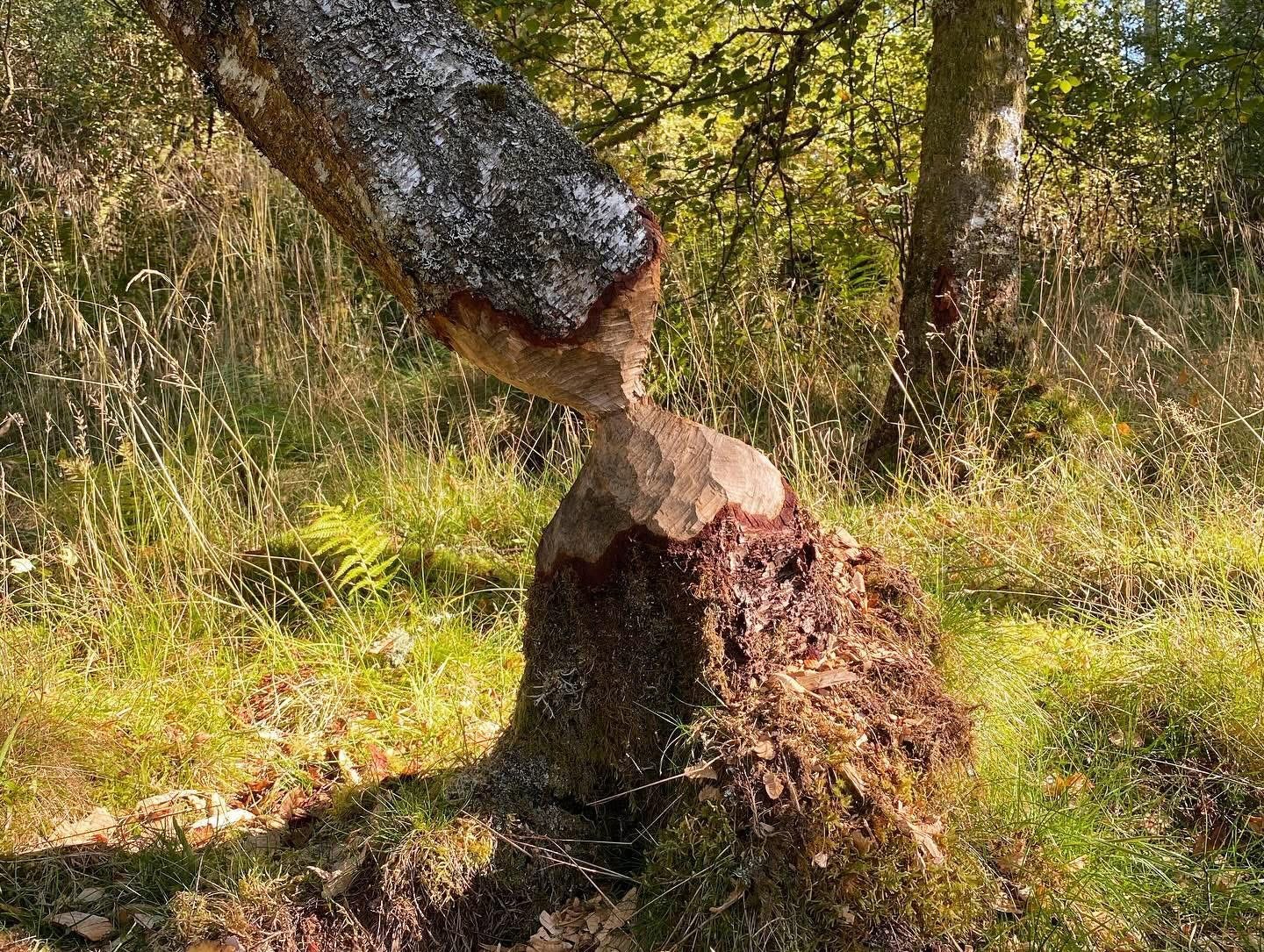
Where trees stood, low coppice appears. They cut whole trunks of downy birch, and willow and sycamore, and then scratch the bark and through the orange cambium with their teeth, leaving pale marks like some ancient text. Saprophitic fungi feast on deadwood. Turkey tail. Tinder fungus. The beavers dam again and again, rearranging water until it is no longer a ditch, but a many pooled river. Greater spearwort and marsh marigold flourish, with their lavish yellow flowers. Melancholy thistle and marsh orchid appear on the banks.
The landscape is a poem we cannot deconstruct, but all the science starts to tell us the same story our eyes and ears are telling us. Diversity is increasing. Infinity looks back at us from the water. We understand the meaning of ‘trophic cascades’ or ‘dynamic habitat’ or ‘keystone species’ in the same way that we know the feeling of a coat on our body.
But the land around remains under sheep. 300 of them on 12 fields. What possibilities are lost to their hard grazing?
Another beginning quietly opens on Hogmanay of 2020, when the Mitchells round up and remove all of the sheep from those fields, and, after a fallow year, we bring a small herd of cattle and a few pigs, and later Exmoor ponies, to roam freely around the area: The fields, the woods, the beaver lands. When did an Exmoor pony - the closest we have to the original wild pony - last roam through a beaver wood?
This story, like the sea, has no end, but is an ever moving present, a torrent of memory and forgetfulness, of breath and motion, of chaos and order and urgency and calm.